

Aluminum Ingots Market to Near $163.5 Billion by 2035 as EV Gigacasting and Decarbonized Smelting Reshape the Industry
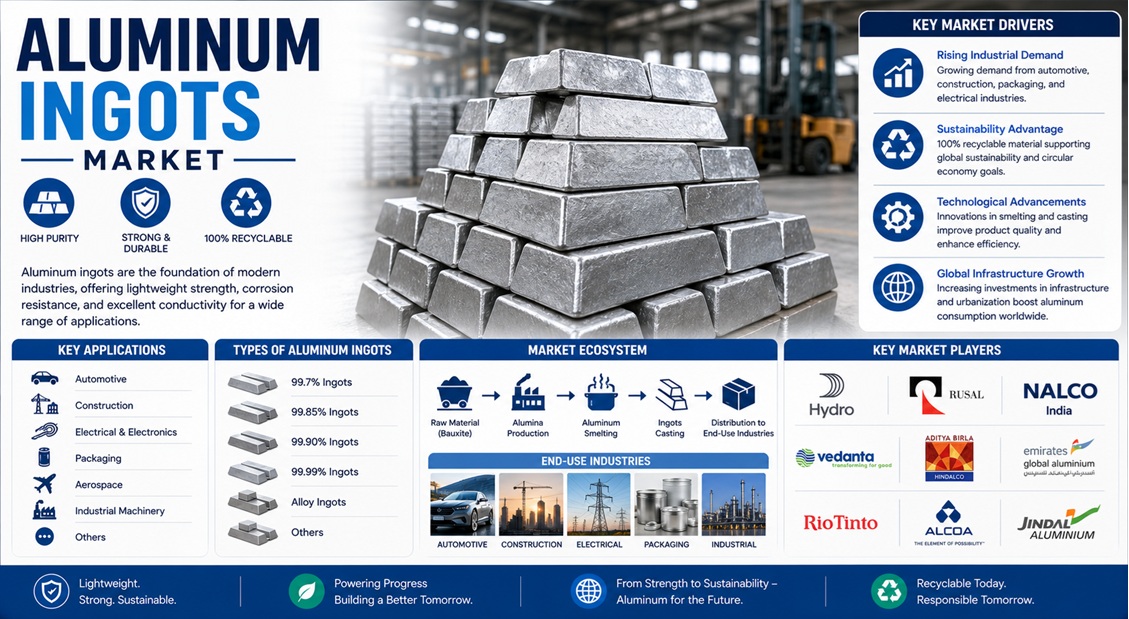
Aluminum Ingots Market (2026 - 2035)
North America is forecast to grow at a 4.8% CAGR as tariff protections and IRA incentives boost domestic smelter output.
NM, UNITED STATES, July 22, 2026 /EINPresswire.com/ -- According to a comprehensive report by Market Research Future (MRFR), the global aluminum ingots market reached an estimated USD 98.5 billion in 2025 and is projected to grow from USD 103.6 billion in 2026 to USD 163.5 billion by 2035, registering a compound annual growth rate of 5.2%. This expansion is being driven by three converging forces: automotive lightweighting mandates that are pushing per-vehicle aluminum content above 250 kg, the commercialization of zero-carbon smelting technologies that could reshape global cost curves, and tightening circular-economy regulations that are elevating recycled ingots from commodity substitute to premium product.The Automotive Imperative: Lightweighting as Regulatory Necessity
The single largest demand driver for the aluminum ingots market is the global automotive industry's race to comply with tightening CO₂ emission standards. The European Union's Fit for 55 package requires passenger-car fleet averages of 93.6 g CO₂/km by 2025 and near-zero by 2035. The U.S. CAFE standards, finalized in March 2024 at 50.4 mpg for MY2031, apply comparable pressure. Every kilogram of aluminum replacing steel saves roughly 20 kg of lifecycle CO₂, making ingot demand structurally tied to regulatory stringency.
Battery electric vehicles use 30–45% more aluminum per unit than comparable internal combustion models, primarily in battery tray castings, motor housings, and crash-energy management structures. Tesla's single-piece gigacasting approach—using 6,000- to 9,000-tonne clamping-force die-cast machines—has driven a wave of copycat investments by Toyota, Hyundai, and Volvo, each allocating USD 1–3 billion to mega-casting facilities through 2027.
This trend directly lifts demand for high-purity foundry ingots in the A356 and A380 alloy families.
Transportation holds approximately USD 31.2 billion in the aluminum ingots market, reflecting surging EV platform demand. The shift to gigacast structural nodes—consolidating dozens of stamped-steel parts into single aluminum castings—dramatically increases ingot pull-through per vehicle. Global OEMs collectively consume over 18 million tonnes of aluminum annually, and the automotive end-user segment anchors the market at roughly 28% share.
Download Report Sample Copy with TOC: https://www.marketresearchfuture.com/sample_request/23133
The Decarbonization Revolution: From Carbon Anodes to Inert Cells
Perhaps the most profound transformation reshaping the aluminum ingots market is the emergence of zero-carbon smelting. The Hall-Héroult process that has dominated primary aluminum production for over a century consumes carbon anodes that react with oxygen to form CO₂—directly emitting roughly 1.5 tonnes of CO₂ per tonne of aluminum. Inert-anode technology replaces these carbon anodes with ceramic or metallic alternatives that emit only oxygen, eliminating direct process emissions entirely.
Rio Tinto and Alcoa's ELYSIS joint venture has committed over USD 550 million to commercialize this technology, with first industrial-scale deployment targeted for 2028 at the Alma smelter in Quebec. In June 2024, ELYSIS completed installation of inert-anode prototype cells at the Alma pilot facility, producing the first commercial-scale batches of zero-carbon aluminum ingots. China's CHINALCO is piloting parallel approaches. The International Energy Agency's Net Zero Emissions scenario assumes that 30% of global smelting capacity transitions to near-zero-carbon processes by 2035—a target that would fundamentally alter the aluminum ingots market cost structure.
Governments in Canada, Norway, and Iceland have offered subsidized hydroelectric capacity to attract next-generation smelter investments, reinforcing the decarbonization push. Hydro-powered smelters in these regions already produce metal with carbon footprints below 4 tonnes CO₂ per tonne of aluminum against an industry average exceeding 8 tonnes. Producers capable of certifying ingots to standards such as the Aluminium Stewardship Initiative (ASI) Performance Standard can unlock price premiums of USD 50–150 per tonne.
The Circular Economy: Secondary Ingots as Premium Product
The aluminum ingots market is undergoing a structural shift from carbon-intensive primary smelting toward recycled production. Secondary (recycled) ingots represent the fastest-growing segment with a projected CAGR of 6.4%, driven by circular-economy mandates and lower energy input requirements. The energy required to produce secondary ingots is roughly 5% of primary smelting energy, conferring both cost and carbon advantages that align with buyer sustainability mandates.
The EU's proposed Packaging and Packaging Waste Regulation (PPWR) mandates minimum recycled-content thresholds for aluminum packaging: 50% by 2030 and 75% by 2040. These requirements are pushing can-sheet producers to invest in closed-loop scrap-sorting infrastructure and expand secondary ingot capacity. Advanced sorting—including laser-induced breakdown spectroscopy (LIBS) and X-ray transmission systems—enables wrought-alloy-grade separation from mixed scrap streams, closing the quality gap between primary and secondary metal.
Consumer-goods companies such as Nestlé, Coca-Cola, and Ball Corporation are signing multi-year closed-loop agreements guaranteeing scrap return from end-of-life packaging. These partnerships stabilize secondary ingot feedstock and reduce reliance on volatile primary metal pricing. Smelter-rollers that build used beverage can (UBC) sorting and remelting capacity adjacent to major consumption hubs stand to capture margin across the aluminum ingots market value chain.
Buy Now: https://www.marketresearchfuture.com/checkout?currency=one_user-USD&report_id=23133
Regional Dynamics: Asia-Pacific Dominates, All Regions Transform
Asia-Pacific commands approximately 62% of the aluminum ingots market, the largest regional share, and simultaneously posts the fastest CAGR at 5.8%. China alone accounts for 52% of regional value, with its smelting base concentrated in Yunnan, Xinjiang, and Inner Mongolia producing over 40 million tonnes annually. Beijing's 45 million tonne per year cap on primary smelting capacity, imposed since 2020, is redirecting incremental growth toward India and Southeast Asia.
India is the region's standout growth story at a 6.8% CAGR. The National Aluminium Policy targets 10 Mt/yr of smelting capacity by 2030, up from roughly 4.1 Mt/yr today. Vedanta, Hindalco, and NALCO together have announced capex growth of over USD 12 billion, tapping captive coal-power blocks and bauxite reserves in Odisha and Chhattisgarh. In January 2026, Hindalco secured environmental clearance for a 0.5 Mt/yr smelter expansion at Aditya Aluminium in Odisha, with commissioning targeted for 2027.
Japan contributes USD 4.1 billion through automotive lightweighting and premium alloy imports. South Korea's 4.5% CAGR reflects EV battery-housing demand and shipbuilding applications. Australia's 4% of regional share is anchored in bauxite mining and alumina-refining exports.
Europe holds the second-largest share at roughly 15%, supported by the EU Carbon Border Adjustment Mechanism (CBAM). The CBAM commenced its transitional reporting phase in October 2023, with financial obligations beginning in 2026. Initial estimates show a price increase of EUR 150–300 per tonne for carbon-intensive imports from China and India, tilting procurement toward domestic or Norwegian supply. Germany anchors regional demand at approximately 24% of share through automotive OEM demand, with Audi and BMW lightweighting programs absorbing over 1.5 Mt/yr of aluminum in body-in-white and powertrain applications.
North America accounts for about 10% of global value, with a forecast CAGR of 4.8%. The U.S. Inflation Reduction Act's Advanced Manufacturing Production Credit (Section 45X) provides per-unit tax credits for domestically produced critical minerals, including aluminum. Century Aluminum's planned USD 1.1 billion greenfield smelter in Kentucky—announced in 2024—signals renewed confidence in domestic primary capacity. Canada remains a cornerstone, with Alouette, Arvida, and Kitimat smelters producing over 3 Mt/yr of hydro-powered metal.
The Middle East & Africa is valued at approximately USD 8.9 billion in 2025, with Gulf states leveraging low-cost energy for greenfield smelters. Emirates Global Aluminium (EGA) and Ma'aden in Saudi Arabia are adding over 1.5 Mt/yr of combined smelting capacity. EGA's Al Taweelah facility, with 2.5 Mt/yr of nameplate capacity, ranks among the world's largest single-site smelters. In September 2023, EGA inaugurated a 5.4 MW solar-powered demonstration project at Al Taweelah, with ambitions to integrate 1 GW of solar capacity into smelting operations by 2030.
South America is advancing at a 4.2% CAGR, with Brazil dominating at 68% of regional share through vertically integrated bauxite-alumina-ingot chains in Pará state. Argentina's ALUAR smelter in Puerto Madryn benefits from Patagonian wind and hydroelectric resources.
Report Summary: https://www.marketresearchfuture.com/reports/aluminum-ingots-market-23133
Product and Segment Dynamics
Primary ingots command the largest share at approximately 68% of global revenue, underpinned by capacity expansions across China and the Middle East. Critical applications—aerospace structural components, high-voltage busbar, and automotive body sheet—require tightly controlled alloy compositions achievable only from primary metal.
Secondary (recycled) ingots are the fastest-growing segment at a 6.4% CAGR. Zorba (shredded mixed aluminum scrap) trades at 55–70% of LME, while Twitch (clean cast scrap) achieves 80–90%. Sorting technology directly determines price realization for secondary ingot producers.
By application, transportation holds approximately USD 31.2 billion, reflecting surging EV platform demand. Construction is expanding at a 5.5% CAGR as green-building certifications favor aluminum façade and framing systems. Packaging end-uses, particularly beverage cans and foil stock, maintain stable single-digit growth. Electrical is advancing at a 5.0% CAGR, driven by grid expansion and renewable-energy infrastructure.
By end user, automotive anchors the market at roughly 28% share. Aerospace & defense is the fastest-growing end-user segment at a 5.7% CAGR, as Airbus and Boeing work through record order backlogs exceeding 13,000 aircraft combined. Each wide-body aircraft contains 60–80 tonnes of aluminum. Building & construction generated USD 14.5 billion in 2025, while electrical & electronics is expanding at a 5.1% CAGR on 5G infrastructure and data-center demand.
Competitive Landscape
The aluminum ingots market exhibits medium concentration, with the top five producers collectively holding an estimated 35–42% of global revenue and a Herfindahl-Hirschman Index in the 800–1,100 range. The competitive landscape spans vertically integrated mining-smelting-rolling conglomerates, standalone primary smelters, and secondary recycling specialists. Scale, energy-cost positioning, and sustainability certification are the primary competitive differentiators.
Alcoa Corporation leads with an estimated 8–11% revenue share, distinguished by its vertically integrated bauxite-alumina-ingot operations and the ELYSIS inert-anode joint venture with Rio Tinto. The company's USD 550 million commitment to zero-carbon smelting technology positions it as the sustainability leader in primary aluminum production.
Rio Tinto captures 7–10% through its global mining and smelting footprint, including the Kitimat hydro-powered smelter in British Columbia and the START blockchain provenance platform. The company's ELYSIS partnership and low-carbon product lines command premium pricing in sustainability-conscious markets.
China Hongqiao Group holds 6–9% as the world's largest private aluminum producer, operating over 6 million tonnes per year of capacity in Shandong Province. The company's scale-driven cost leadership and captive power plants provide structural advantages in the Chinese domestic market.
Vedanta Limited accounts for 5–8% through its Indian operations, including the Jharsuguda and Balco smelters. The company's USD 3 billion capital expenditure plan targets expansion to 3 million tonnes per year by 2030, positioning it as the fastest-growing major producer globally.
Hindalco Industries accounts for 4–6% as India's largest integrated aluminum producer, with the Aditya Aluminium smelter expansion securing environmental clearance in January 2026. The company's Novelis subsidiary is the world's largest recycler of aluminum beverage cans, creating closed-loop synergies.
Chalco (Aluminum Corporation of China) holds 3–5% as the state-owned Chinese giant, operating the world's largest single-country smelting portfolio. Aluminum Bahrain (Alba) captures 3–5% through its Line 6 expansion, which brought total capacity to 1.6 million tonnes per year. Ma'aden (Saudi Arabian Mining Company) accounts for 2–4% through its Ras Al Khair smelter joint venture with Alcoa, while Century Aluminum holds 2–4% with its planned USD 1.1 billion Kentucky greenfield smelter signaling renewed U.S. primary capacity investment.
Related Report
Aluminum Trihydrate Market https://www.marketresearchfuture.com/reports/aluminum-trihydrate-market-5922
Aluminum Honeycomb Market https://www.marketresearchfuture.com/reports/aluminum-honeycomb-market-4192
aluminum smelting market https://www.marketresearchfuture.com/reports/aluminum-smelting-market-25896
Aluminum Foil Packaging Market https://www.marketresearchfuture.com/reports/aluminum-foil-packaging-market-5117
aluminum nitride ceramic substrates in electronic market https://www.marketresearchfuture.com/reports/aluminum-nitride-ceramic-substrates-in-electronic-market-27467
Aluminum Flat-Rolled Products Market https://www.marketresearchfuture.com/reports/aluminum-flat-rolled-products-market-8211
Market Research Future
Market Research Future
+1 855-661-4441
email us here
Legal Disclaimer:
EIN Presswire provides this news content "as is" without warranty of any kind. We do not accept any responsibility or liability for the accuracy, content, images, videos, licenses, completeness, legality, or reliability of the information contained in this article. If you have any complaints or copyright issues related to this article, kindly contact the author above.
